
Fraktur Blackletter, Decoded to English
Fraktur — the dense, angular German print — fills old Bibles, newspapers, church bulletins, and certificates. Its letterforms trip up modern readers and ordinary OCR alike. Upload a page and get clean English.
Drop a photo of your old letter here
or click to select — free & no sign-up required
Germany's Printing Typeface for 400 Years
Fraktur emerged in the early 1500s — an ornate blackletter type first commissioned for Emperor Maximilian I — and went on to dominate German printing for four centuries. Books, newspapers, official forms, and certificates were set in Fraktur right up until 1941, when the regime ordered a switch to Roman (Antiqua) type. If you have a printed German document older than about 1945, it is very likely in Fraktur.
Why Fraktur Defeats Modern Eyes and OCR
Fraktur is studded with traps: the long s (ſ) that reads like an f, tight ligatures for ch, ck, and tz, and capital letters whose shapes confuse even careful readers — the Fraktur A, B, I, J, S, and V are notorious. Standard OCR built for modern fonts stumbles badly on it, which is why so much Fraktur material has never been digitized into searchable text.
Where You'll Find It
Printed church records, baptismal certificates (Taufscheine), gravestones, German-American community newspapers, and family Bibles — often with handwritten Familienchronik entries on the flyleaf — are full of Fraktur. Transcribing it turns a beautiful but unreadable page into names, dates, and places your family can actually use.
What you'll find — and what our AI can read
- Fraktur — the dominant German blackletter typeface
- Schwabacher — an earlier related blackletter type
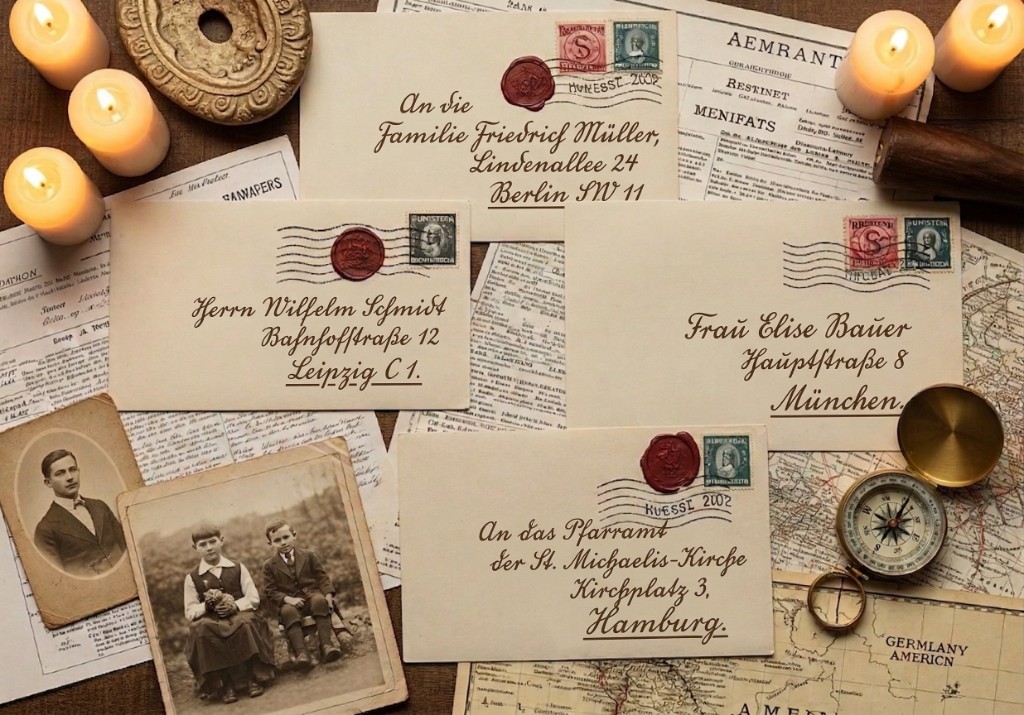
- Handwritten Kurrent or Sütterlin notes in the margins
From old script to English text
Related articles
Kurrent, Suetterlin, or Fraktur? How to Identify the Script on Your German Document
Can't read your German ancestor's handwriting? Learn to identify whether it's Kurrent, Suetterlin, or Fraktur — with visual clues, date ranges, and a quick identification method.
Read article400 Years of German Handwriting: A Timeline for Genealogists
Timeline of German handwriting from 1500s Kurrent to 1941 Latin switch. Date your ancestor's documents by their script and understand what changed — and why.
Read articleHow to Read Old German Handwriting: Your First Steps to Decoding Ancestor Letters
Practical guide to reading old German handwriting (Kurrent & Suetterlin). Letter-by-letter decoding strategies, common word patterns, and when to use AI transcription for your family documents.
Read articleHow to Get Old German Letters Translated into English Online
Complete walkthrough: from an unreadable old German letter to English text in your inbox. How AI handles transcription and translation in one step, what to expect, and when to combine approaches.
Read article