Germans from Russia Letters, Unlocked
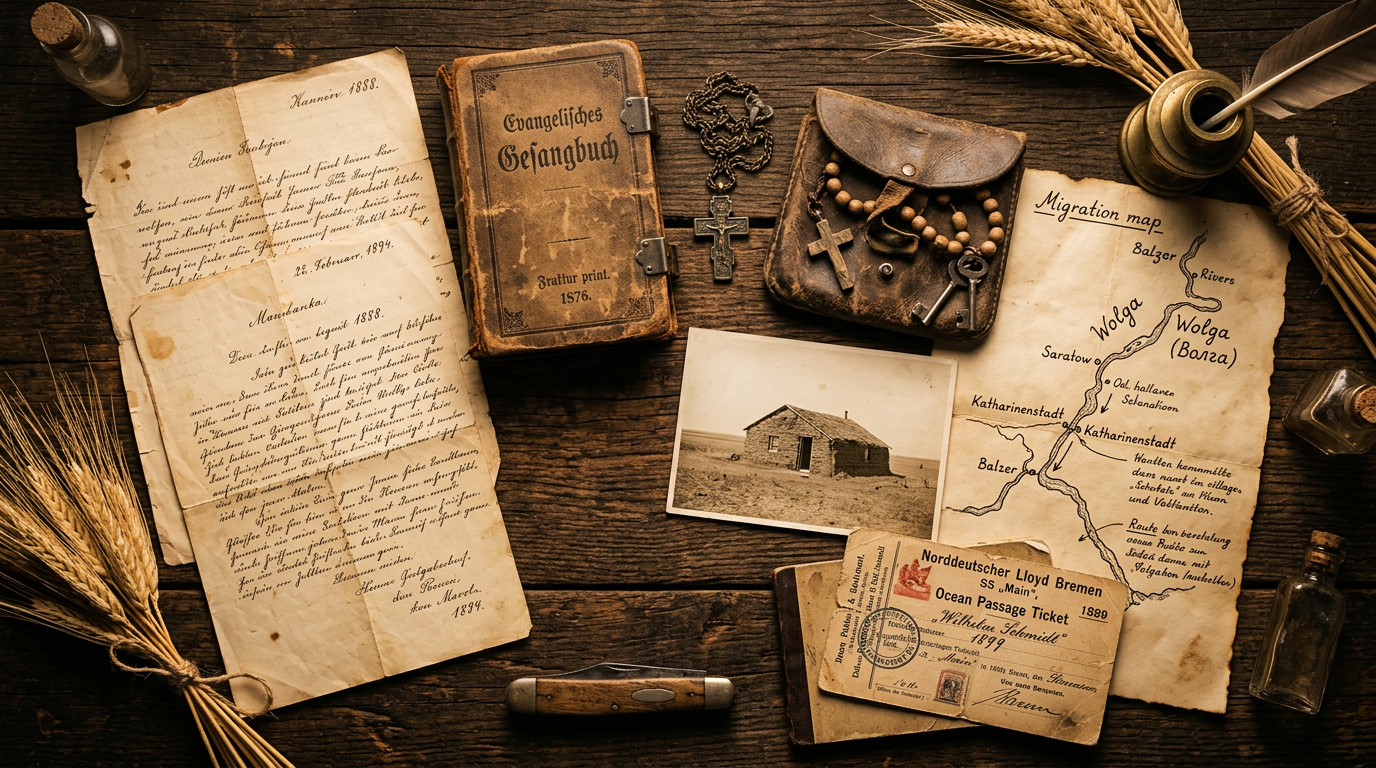
From the Volga to the Great Plains — German-Russian families preserved letters and documents in Kurrent and Fraktur across two continents and three centuries. Finally read what they wrote.
Drop a photo of your old letter here
or click to select — free & no sign-up required
From Germany to Russia and Back
In the 1760s, Catherine the Great invited German settlers to colonize the Russian steppe along the Volga River and near the Black Sea. These colonists — predominantly from Hessen, the Rhineland, and Württemberg — maintained their German language, religion, and customs for over a century in isolated settlements. They wrote in Kurrent, kept church records in German, and printed community documents in Fraktur. When conditions deteriorated in Russia in the late 19th century — loss of privileges, military conscription, Russification — they emigrated again, this time to the American Great Plains: Kansas, Nebraska, the Dakotas, Colorado, and beyond.
A Unique Documentary Heritage
Germans from Russia families often possess documents from three distinct eras: the original German homeland (pre-1760s), the Russian colonial period (1760s–1870s), and American settlement (1870s onward). Letters might be written in 18th-century Kurrent from a Volga village, in 19th-century German from Odessa or Saratov, or in Suetterlin from a homestead in North Dakota. Church records from the colonies — many now lost in Russia — survive in family collections and community archives. This three-century documentary chain makes Germans from Russia genealogy exceptionally rich, but the old scripts create a formidable barrier.
Community and Resources
The Germans from Russia Heritage Society (GRHS), headquartered in Bismarck, North Dakota, is the premier organization for this community. Their archives hold thousands of documents, family histories, and village records. The American Historical Society of Germans from Russia (AHSGR) in Lincoln, Nebraska, provides additional resources. Local historical societies across the Great Plains — from Hays, Kansas, to Strasburg, North Dakota — preserve the material culture of these communities. If your family descends from Volga Germans or Black Sea Germans, there's a strong chance that unread letters in Kurrent sit in a family collection, waiting to be transcribed.
What you'll find — and what our AI can read
- Kurrent script — used from the original colonies through the early 1900s
- Suetterlin — in later American correspondence
- Fraktur — in printed church records and community documents
From old script to English text
Related articles
German-American Genealogy: Why Family Letters Are Your Most Powerful Research Tool
How handwritten German immigrant letters can break through genealogy brick walls. What they reveal that census records and ship manifests can't — and how to make them readable.
Read articleGerman Church Records (Kirchenbücher): The Genealogist's Guide to Finding and Reading Them
Where to find German Kirchenbücher online, what each record type contains (baptism, marriage, death), how to decode the script and Latin abbreviations, and how to get them transcribed.
Read article400 Years of German Handwriting: A Timeline for Genealogists
Timeline of German handwriting from 1500s Kurrent to 1941 Latin switch. Date your ancestor's documents by their script and understand what changed — and why.
Read articleFrom Shoebox to Story: Getting Your German Immigrant Letters Transcribed
Step-by-step guide to transcribing German immigrant letters. From photographing fragile originals to receiving readable English text — everything you need to unlock your family's transatlantic correspondence.
Read article