
Kurrent Script, Finally Readable
For four centuries, Germans wrote in Kurrent — the spiky old handwriting that fills 18th- and 19th-century letters, church books, and legal records. Upload a photo and get a clear English transcription.
Drop a photo of your old letter here
or click to select — free & no sign-up required
Four Centuries of German Writing
Deutsche Kurrentschrift grew out of late-medieval Gothic cursive and became the everyday German hand from the 16th century until the early 20th. Anything written by a German speaker before roughly 1900 — and much written until 1941 — is likely in Kurrent. Because the same script was used for so long, its letterforms also drifted over time and varied by region and writer, which is part of what makes it so challenging.
Kurrent vs. Sütterlin
People often confuse the two. Sütterlin (introduced 1915) is a simplified, upright schoolroom version of Kurrent. The older, pre-WWI letters, colonial-era records, and 18th- and 19th-century documents are written in true Kurrent — generally more slanted, more variable, and harder to decipher than Sütterlin. Both share the same DNA, so a tool that reads one needs to handle the other too.
The Key to Pre-1900 Genealogy
Church registers (Kirchenbücher), emigration and passenger lists, wills, guild papers, and civil records from before about 1900 are almost all in Kurrent. For family historians tracing a line back across the Atlantic, the ability to read Kurrent is often the single barrier between a brick wall and a confirmed ancestor in a specific German village.
What you'll find — and what our AI can read
- Kurrent — the standard German hand, 1500s to early 1900s
- Chancery (Kanzlei) hands — formal and legal variants
- Sütterlin — the 20th-century simplification of Kurrent
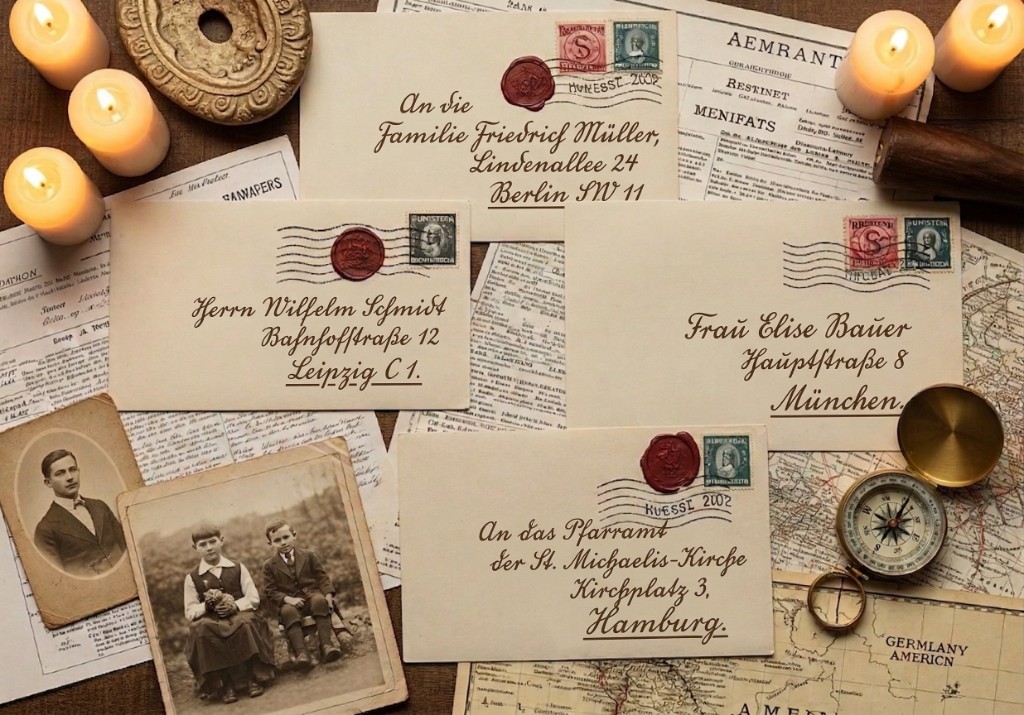
From old script to English text
Related articles
Kurrent, Suetterlin, or Fraktur? How to Identify the Script on Your German Document
Can't read your German ancestor's handwriting? Learn to identify whether it's Kurrent, Suetterlin, or Fraktur — with visual clues, date ranges, and a quick identification method.
Read articleHow to Read Old German Handwriting: Your First Steps to Decoding Ancestor Letters
Practical guide to reading old German handwriting (Kurrent & Suetterlin). Letter-by-letter decoding strategies, common word patterns, and when to use AI transcription for your family documents.
Read articleHow to Get Old German Letters Translated into English Online
Complete walkthrough: from an unreadable old German letter to English text in your inbox. How AI handles transcription and translation in one step, what to expect, and when to combine approaches.
Read article400 Years of German Handwriting: A Timeline for Genealogists
Timeline of German handwriting from 1500s Kurrent to 1941 Latin switch. Date your ancestor's documents by their script and understand what changed — and why.
Read article