
Sütterlin Handwriting, Transcribed to English
The looping Sütterlin script filled German letters, diaries, and postcards for much of the 20th century — and almost no one can read it today. Upload a photo and get a clear English transcription in minutes.
Drop a photo of your old letter here
or click to select — free & no sign-up required
A Script Designed for German Schools
Sütterlinschrift was created by the Berlin graphic artist Ludwig Sütterlin around 1911 and rolled out in Prussian schools from 1915. It was a deliberately simplified, upright form of the older Kurrent handwriting, meant to be easier for children to learn with a uniform-width pen. For roughly a generation it was THE handwriting of Germany — until the Nazi regime abruptly banned it in 1941. That means most surviving 20th-century German family documents, written by people schooled between the wars, are in Sütterlin.
Why It's So Hard to Read Today
Sütterlin looks deceptively familiar but trips up modern readers at every turn. The letters e, n, m, and u are nearly identical; the long s (ſ) looks like an f; the h, f, and g drop dramatic loops below the line; and capital letters bear little resemblance to their modern counterparts. Because schools stopped teaching it over 80 years ago, even native German speakers under 80 usually cannot read a Sütterlin letter without training.
The Most Common Script in Family Collections
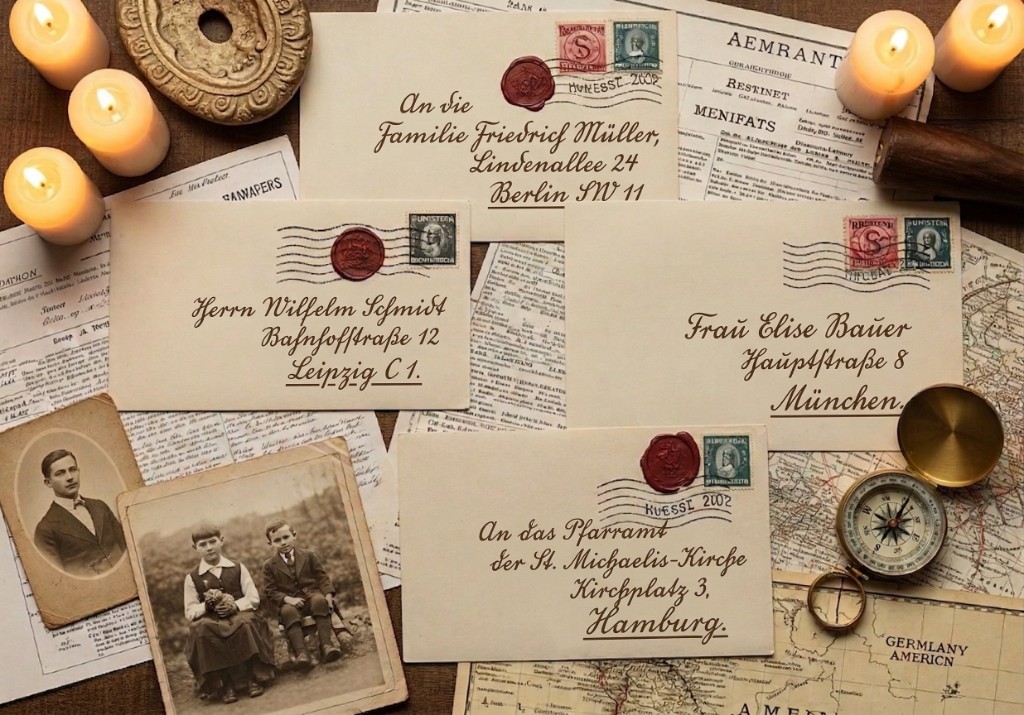
If your family kept letters, a diary, field-post (Feldpost) from either World War, postcards, or a handwritten recipe book, there is a strong chance they are in Sütterlin. These are exactly the heirlooms descendants most want to read — a grandmother's diary, a soldier's last letter home — and exactly the ones that have stayed locked behind an unreadable script for decades.
What you'll find — and what our AI can read
- Sütterlin — the German school script of 1915–1941
- Kurrent — the older parent script Sütterlin simplified
- Post-war transitional hands — mixed Sütterlin and Latin letters
From old script to English text
Related articles
Your Grandparent's Handwriting: Pure Suetterlin or Post-War Hybrid?
Documents from 1940–1975 often mix Suetterlin with Latin letters. Learn to spot the hybrid, understand why it exists, and what it means for transcription accuracy.
Read articleKurrent, Suetterlin, or Fraktur? How to Identify the Script on Your German Document
Can't read your German ancestor's handwriting? Learn to identify whether it's Kurrent, Suetterlin, or Fraktur — with visual clues, date ranges, and a quick identification method.
Read articleHow to Read Old German Handwriting: Your First Steps to Decoding Ancestor Letters
Practical guide to reading old German handwriting (Kurrent & Suetterlin). Letter-by-letter decoding strategies, common word patterns, and when to use AI transcription for your family documents.
Read article400 Years of German Handwriting: A Timeline for Genealogists
Timeline of German handwriting from 1500s Kurrent to 1941 Latin switch. Date your ancestor's documents by their script and understand what changed — and why.
Read article